A 69-day reporting window in NASA’s landing-test timeline
An August 27 flight and a November 4 article mark different events. The timeline separates completed tests, publication dates and planned milestones.

Two clocks for one report
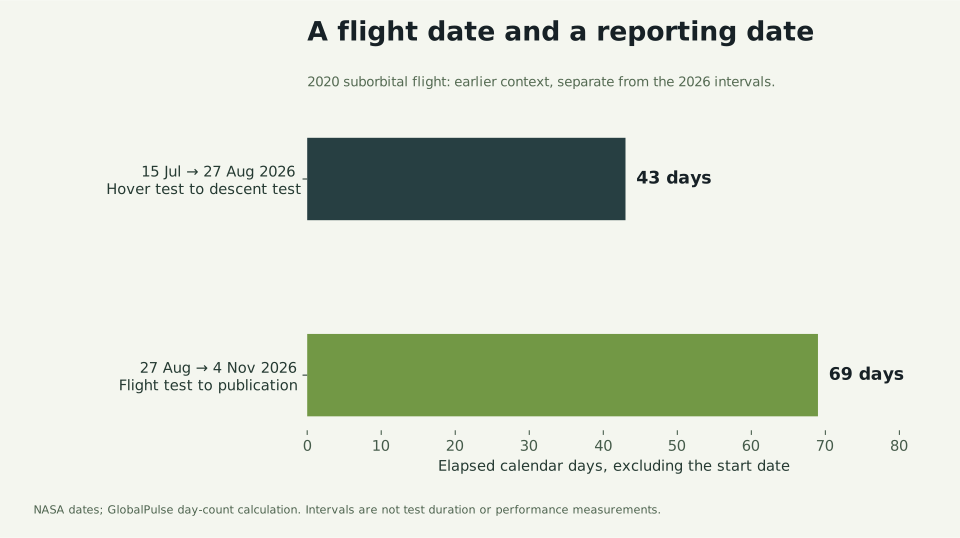
NASA’s November 4 account describes a simulated lunar-descent flight conducted on Earth on August 27. Subtracting those calendar dates produces 69 elapsed days. The interval identifies when the reported work happened and when its account appeared; it does not measure test duration, staff effort or a communications failure.
Dated photo captions supply another point: a July 15 hover test of communications between SPLICE and the Alta-X drone. July 15 to August 27 spans 43 elapsed days. We calculate both intervals at UTC midnight and exclude the start date. June and July integration references without exact dates are excluded from day-level arithmetic.
Keep historical context dated
A separate NASA account provides historical context. Its editor’s note confirms that NS-13 launched and landed on October 13, 2020, carrying an integrated computer and two SPLICE sensor systems. The article’s later update date belongs to the publication record. It does not move that flight into 2026.
Planned work stays separate
The next visual row should remain separate from completed work: a Voyager full-scale test was planned for November in the 2026 source. These pages establish no completed result for that step. They also supply no numerical landing-error benchmark or completed lunar landing. A later entry needs a primary account of the outcome and its operating conditions before it can extend the completed timeline.
| Calculation | Result | Unit |
|---|---|---|
| Hover test to simulated-descent flight | 43 | elapsed calendar days |
| Reported flight to article publication | 69 | elapsed calendar days |
Sources and method
NASA Navigation Experiment Shows Promise for Planetary Landings ↗
This is an original GlobalPulse research note or commentary. Its selection rules, judgments and limits are set out above. Read our editorial standards.